 Anxiety Remedy
Home & Garden · Guide Review
Energy Revolution Reviews: $39 Guide, Honest Verdict
 60-Day Money-Back Guarantee via ClickBank
Verdict: $39 once, plus $50–$70 in parts — about 65 cents a day if you spread the guide over its 60-day refund window. What you actually buy is straightforward: a PDF blueprint plus video tutorials that teach you to build a small coil-and-magnet device at home, with a 60-day ClickBank refund. What the sales page sells around it is not straightforward at all: a suppressed Tesla blueprint, free unlimited electricity, and bills cut by half or more. No independent test shows a build from this guide doing any of that, and the site itself calls the product an experiment that was never technically assessed. Buy the guide if you enjoy the build. Do not buy it expecting your meter to stop.
Get Today's Price on the Official Site →Prices checked November 2026 · $39 one-time for the digital guide; parts are extra and you buy them yourself.
How much does Energy Revolution really cost?
$39 buys the instructions. The parts, the afternoon, and the meter reading are all extra — so here is the full cost, not just the headline one:
| Item | Cost | Notes |
|---|---|---|
| Guide (PDF + videos + bonuses) | $39 | One-time payment, no subscription |
| Parts for a small build | $50–$70 | Magnets, wire, rotors, connectors; one reviewer spent $68.50 |
| Parts for a larger build | Up to $200 | Third-party estimate; unverified |
| Realistic first-build total | $89–$109 | Guide plus small-build parts, before your time |
Most sources cite $39 for the guide; some cite $49, and one marketplace report lists an average payout value around $50. The page shows a $149 "regular" reference price, which is a marketing anchor — the price people actually pay is $39. The guide is a one-time payment. Spread over the 60-day refund window, the $39 guide alone works out to 65 cents a day (39 ÷ 60) — the parts are the real cost: one reviewer spent $68.50 on components, so a first build totals $107.50 before your time. Prices are set by the seller and they can change, so confirm the checkout total before you pay.
The quick take
- What it is: a digital DIY guide (PDF blueprint plus video tutorials) that teaches you to build a small coil-and-magnet energy device at home. You buy the instructions — not a finished machine.
- What it costs: $39 one-time for the guide, most sources agree. Parts are extra: third-party estimates run $50 to $70 for a small build, and up to $200 for a larger one.
- The claim: a suppressed Tesla blueprint for unlimited free electricity, with bills cut 50–80%. No independent measurement backs that up, and the site itself says the product was never technically assessed.
- The guarantee: 60 days, money back, handled through ClickBank as the retailer.
- My take: as a $39 hobby build with a refund window, it is low-risk. As a way to stop paying for electricity, it is a story — and the story breaks the laws of physics.
My rating is
Best for: hands-on homeowners who enjoy a weekend build, understand they are buying instructions, and will treat any savings claim as unproven until their own meter says otherwise.
What is Energy Revolution?
Forget the word 'device' for a minute: Energy Revolution — sold as the Energy Revolution System — is a digital guide, not a machine. You pay once, you download a PDF blueprint and video tutorials, and you follow step-by-step instructions to build a small energy-generating device at home from magnets, wire, rotors and connectors. Nothing ships to your door. There is no finished machine in the box, because there is no box. That distinction matters more than anything else on this page, because the sales copy does everything it can to blur it.
The story on the page goes like this: before J.P. Morgan cut his funding and agents confiscated his files, Nikola Tesla perfected a $200 device for unlimited free electricity. The blueprint was suppressed for 80 years. Now it is back, and 102,244 families are using it to never pay for electricity again. The author writes under the pen name Michael Garnett. The retailer is ClickBank, which handles the payment and the refund. The site is theenergyrevolution.net, and its own footer carries a disclaimer worth quoting in plain language: the product is an experiment, it was not technically assessed, and it has not been individually produced or mass-produced. Hold that sentence next to the "never pay for electricity again" headline and you have the whole review in miniature.
One confusion to clear up first, because the name invites it: there is also a supplement offer floating around under the "Energy Revolution" name, built on a powdered drink called MetaBoost. That is a different product from a different seller. The link supplied for this review resolves to the DIY home-energy guide on theenergyrevolution.net — the Tesla-blueprint guide — and that is the product this page reviews. If you came here looking for the supplement, you are on the wrong page, and the supplement is not what the link sells.
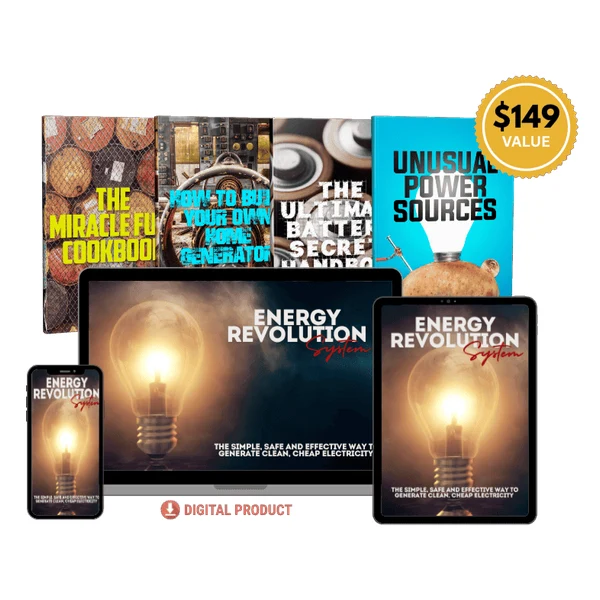
The guide is aimed at homeowners who want a supplemental power source, a backup for outages, or a way to cut their bill. It is sold as a one-time $39 purchase with four bonus guides — "The Miracle Fuel Cookbook", "How to Build Your Own Home Generator", "The Ultimate Battery Secrets Handbook" and "Unusual Power Sources", as shown on the live sales page — and a 60-day money-back guarantee through ClickBank. Everything after this paragraph is a check of those facts against what the guide can actually do.
Why the free-energy story sells
Electricity bills are one of the few costs that arrive every month, go up most years, and feel entirely outside your control. A story that says a genius already solved it, a banker buried it, and a $39 guide hands it back to you is built to land in exactly that frustration. It gives you a villain, a hero, a secret, and a price so low that trying it feels cheaper than staying angry.
What's inside the package
No capsules, no doses — this is a guide, so the 'contents' are files and a shopping list. Here is what the bundle actually contains, as described across the official page and third-party write-ups:
| Component | What It Is | What It Does |
|---|---|---|
| Main blueprint (PDF) | Printable manual | Step-by-step assembly instructions with diagrams for the coil-and-magnet device |
| Video tutorials | Supporting lessons | Walk-throughs of the build, aimed at beginners with no electrical background |
| Parts list & sourcing guide | Shopping list | Lists the magnets, wire gauge, rotors and connectors, with advice on where to buy them locally |
| Bonus: The Miracle Fuel Cookbook | Digital extra | Fuel recipes — the first of four bonus guides on the live page |
| Bonus: How to Build Your Own Home Generator | Digital extra | A second build guide, alongside the main blueprint |
| Bonus: The Ultimate Battery Secrets Handbook | Digital extra | Battery guidance — the third bonus on the live page |
| Bonus: Unusual Power Sources | Digital extra | Alternative power ideas — the fourth bonus on the live page |
| Parts you buy yourself | Not included | Third-party estimates $50–$70 for a small build; up to $200 for a larger one |
Two honest notes. First, the contents are modest and the page is fairly clear about that once you get past the headline: a manual, some videos, a parts list, four bonus PDFs. That is a normal $39 information product, and there is nothing strange about the format. Second, the bonus titles differ between sources — other write-ups name "Energy Efficiency Guide" and "Backup Power Tips" instead of the four titles on the live page — so treat the exact bonus list as "four extra guides" rather than a fixed set of named files. The core of the purchase is the blueprint. Everything else is wrapping.
What the package does not contain is any finished device, any installed hardware, or any measurement of what a finished build produces. You build the device yourself, from parts you buy separately, and whether it does anything useful is something you find out after the build, not before. That is the deal, and it is worth stating plainly because the headline works hard to make you forget it.
How you use it
There is no dose and no daily routine — the "use" here is a build, and it runs like any small DIY project. You download the PDF and the videos, read the parts list, buy the magnets, wire, rotors and connectors from a hardware or electronics store, then follow the step-by-step assembly. One reviewer who followed the guide reported spending $68.50 on components, inside the advertised budget, and described the diagrams in the current edition as clearer than earlier versions.
How long it takes depends on your hands. The guide is written for beginners with no electrical background, and the current edition is marketed with clearer diagrams and an updated parts list. Expect an afternoon rather than an hour, and expect to re-read steps — that is normal for a first build from a manual. The device is meant to supplement your mains supply, not replace it, according to the more careful third-party descriptions. Do not wire a home-built generator into your house mains. That is electrician work, and the guide's own footer warns that some home alterations may be illegal in your area and that you should check with your local authority first.
Does Energy Revolution work? What the evidence says
Two things can both be true: the guide is real, and the savings claim is not proven — the physics behind it does not add up.
Start with the physics, because it is the shortest route to the truth. A coil-and-magnet device is a generator: it turns motion into electricity. It does not create energy. Every generator needs an input — spinning the rotor by hand, by wind, by water, by an engine — and the electricity you get out is always less than the energy you put in, because some is lost as heat and friction. That is conservation of energy, and it is not a rule a PDF can waive. A small home-built device with no fuel, no wind and no water input cannot produce "unlimited free electricity", because there is no energy coming in to convert. What it can do, at best, is demonstrate the principle on a small scale, or serve as a supplemental source if you drive it with something else.
Now the evidence. I found no independent measurement — no lab test, no metered before-and-after, no published trial — showing that a build from this guide cuts a household electricity bill by the amounts advertised, 50 to 80% in some marketing. Third-party reviews that have looked at the same offer say the same thing: the guide exists, the build is described clearly enough, and the performance claims could not be verified. The site's own disclaimer goes further than any reviewer: the product is an experiment, it was not technically assessed, and it has not been individually produced or mass-produced. A seller that writes that sentence in its own footer is telling you, in legal language, that nobody has checked whether the thing works.
There is one honest use for a guide like this. If you like building things, the $39 buys you a weekend project with diagrams, a parts list and videos — and a small generator you built yourself is a satisfying object even if it never powers more than a light bulb. What it does not buy you is a way out of your electricity bill. Judge the guide as a hobby build and it is fairly priced. Judge it as an energy solution and it fails its own headline.
What results are actually realistic?
Never paying for electricity again is the sales page's line. Here is the version a small coil-and-magnet build can actually deliver:
- After the build: you have a small working generator you assembled yourself. It demonstrates the principle. It may run a small load — a light, a phone charger — if it is driven properly. That is a real result, and for a hobbyist it is a satisfying one.
- On your bill, month one: expect nothing measurable. A device this size, with no fuel input, cannot move a household meter. If your bill drops, look first at the weather, the season, or the efficiency tips in the bonus guide — those do save money, and they have nothing to do with the device.
- Months 2 to 3: the realistic win is knowledge, not kilowatts. You understand generators better, you have a backup conversation piece, and you have the efficiency guide's habits. None of that is worthless. None of it is "free electricity" either.
One line that belongs in every review of this product: there is no independent measurement of a build from this guide cutting a household bill. The headline numbers — 50 to 80% savings, a meter that stops, 102,244 families free of bills — are marketing figures, not measurements. Treat them as such.
What to know before you buy
I kept tripping over the same four things on the sales page. Check them before you order:
- The Tesla story is a story. "They buried Tesla's blueprint twice" is a sales narrative, not a documented history. Tesla did work on wireless power and did lose funding — J.P. Morgan did withdraw support for his Wardenclyffe project — but there is no suppressed blueprint for a $200 home device that makes unlimited free electricity, and no confiscated file that this guide reproduces.
- The site disclaims its own product. The footer says the product is an experiment, was not technically assessed, and has not been individually produced or mass-produced. That is the seller telling you nobody has verified the device works.
- "102,244 families" is an unverifiable number. The page publishes no source, no survey and no way to check it. Treat it as a headline, not a headcount.
- The real cost is $39 plus parts plus your time. The guide is $39. The parts are $50 to $70 for a small build, more for a bigger one, and the build takes an afternoon. The honest total for a first build is roughly $90 to $110 before you count your time.
To be fair, though. The purchase is a single one-time payment with no subscription, checkout runs through ClickBank with a 60-day refund, delivery is instant and digital, and the guide's own contents — blueprint, videos, parts list — are described plainly once you get past the headline. The product is real. The claim is the problem.
The 60-day guarantee: how it works
If there is a solid part to this offer, it is the refund — a standard ClickBank one. You have 60 days from purchase to ask for your money back, and refund requests go through ClickBank order support at clkbank.com with your order number. ClickBank is the retailer here, so the refund path does not depend on the seller answering an email — that is the reliable part of the transaction, and it is worth more than the seller's own promises.
How to use it well: build the device inside the 60 days, test it honestly, and keep your order confirmation. If the build does nothing useful for you, ask for the refund while the window is open and keep a copy of the request. Sixty days is enough time to buy parts, build the thing and see what it does. It is also, notably, the same window ClickBank gives on most digital products — there is nothing special about it, and the page does not claim otherwise.
One practical note: the guarantee covers the $39 guide. It does not cover the parts you bought at the hardware store. Those are yours whether the build works or not, which is another reason to keep the first build small and cheap.
What customers say
What did buyers say in the write-ups I could read? The consistent thread is that the guide itself is usable — diagrams, parts list, videos — and the consistent gap is that nobody publishes a metered result. One reviewer put $68.50 of parts into the build and described the process, not a bill reduction. That is the honest shape of the feedback: a workable hobby build, and silence where the savings proof should be. When a product's loudest claim has no buyer holding a metered bill next to it, that silence is data.
Energy Revolution pros and cons
- A real digital product: blueprint, videos and parts list for $39
- One-time payment, no subscription, instant delivery
- 60-day refund through ClickBank, a real refund path
- Beginner-friendly format with clearer diagrams in the current edition
- Bonus efficiency guide teaches savings that actually work
- Low-risk as a hobby build — you learn how generators work
- "Free unlimited electricity" breaks conservation of energy
- No independent measurement of any bill saving
- The site itself calls it an unassessed experiment
- "102,244 families" is published with no source
- Real cost is $39 plus $50–$70 in parts plus your time
- Author writes under a pen name; no verifiable builder behind it
Who should consider it, and who should skip it
- You enjoy DIY builds and want a $39 weekend project with a refund window
- You want to learn how a small generator works, hands-on
- You will judge it on the build, not on your electricity bill
- You are buying it to cut or replace your electricity bill — it will not do that
- You want a finished device shipped to your door — this is instructions only
- You have no interest in hands-on assembly or buying parts separately
- You would wire a home-built device into your house mains — get an electrician, not a PDF
Safety: what to check before you start
This is a DIY electrical build, so the safety section is not boilerplate — it is the section. A small coil-and-magnet generator is low-voltage and low-risk as a tabletop project, but the moment you scale it up or connect it to anything in your house, the risk changes completely.
The cautions that actually matter:
- Never wire a home-built device into your house mains. Mains wiring is electrician work in every jurisdiction I know. A DIY generator connected to household wiring can back-feed, shock someone, or start a fire. Use the build as a standalone project only.
- Check local rules first. The site's own footer warns that some home alterations may be illegal in your town or city and that you should ask your local authority. Take that seriously before you build anything larger than a tabletop demo.
- Keep it small on the first build. Small parts, small voltages, no mains connection. If the build grows, get a qualified electrician involved before it touches anything wired into your home.
If you are not comfortable with basic electrical safety — insulation, no live working, keeping the build away from water — this is not the project to learn on alone. The $39 guide is cheap. A mistake with mains electricity is not.
Energy Revolution FAQ
Is Energy Revolution a scam? –
No — based on what I checked, it is a real digital guide with a working ClickBank checkout and a 60-day refund. What is not real is the headline claim: no independent test shows a build from this guide producing free electricity or cutting bills by half.
Does Energy Revolution work? +
As a build guide, yes — buyers describe it as clearly written and doable. As an energy solution, I cannot say it does. A coil-and-magnet device needs an energy input, and no metered result has been published showing a bill saving from a build.
What do you actually get for $39? +
A PDF blueprint, video tutorials, a parts list and sourcing guide, plus four bonus guides — the live page shows a fuel cookbook, a home-generator guide, a battery-secrets handbook and an unusual-power-sources guide, though other sources name different titles. You do not get a finished device — you build it yourself from parts you buy separately.
How much does Energy Revolution cost in total? +
$39 for the guide, plus $50 to $70 in parts for a small build — so roughly $89 to $109 for a first build, before your time. Larger builds can run to $200 in parts. Prices were checked in November 2026 and they can change.
Is there an Energy Revolution refund policy? +
Yes — a 60-day money-back guarantee through ClickBank. Ask for the refund through ClickBank order support with your order number. The guarantee covers the $39 guide, not the parts you bought.
Can it really cut my electricity bill by 50–80%? +
I found no independent measurement supporting that. The site itself calls the product an experiment that was never technically assessed. The efficiency tips in the bonus guide can save money — the device, on its own, has no verified saving.
Is Energy Revolution a supplement? +
No. The link supplied for this review resolves to the DIY home-energy guide. A different supplement offer shares the name — do not confuse the two.
Is it safe to build? +
As a small tabletop project, yes, with normal care. Never wire a home-built device into your house mains, and check local rules before building anything larger. Mains work belongs to a qualified electrician.
Final verdict: is Energy Revolution worth it?
The 3.5 lands where it does because the two halves of this product pull in opposite directions. On one side: a real $39 blueprint with videos and a parts list, a one-time payment, and a genuine 60-day ClickBank refund — a fair price for a weekend build. On the other: a headline claim that breaks conservation of energy, has no independent measurement behind it, and is disclaimed by the seller's own footer. The guide earns its points; the story around it loses them.
My take: if you want a cheap weekend build and you will judge it on the pleasure of making a small generator with your own hands, $39 is a fair price for the guide. If you want a lower electricity bill, spend the $39 on the efficiency habits in the bonus guide and skip the device — or better, put the whole $100 toward insulation and LED bulbs, which actually move a meter.
Final score = weighted average of the five categories above. Full method on our How We Review page.
Get Today's Price on the Official Site →How I checked this: the official Energy Revolution sales page at theenergyrevolution.net, reached through the supplied link ($39 against a $149 strike price, four bonus guides, pen name Michael Garnett, experiment disclaimer, ClickBank retailer wording); corroborating reviews for the $39 price, the $50–$70 parts estimate and the 60-day guarantee; no independent metered test of the savings claims could be found. Sources: How We Review · Affiliate Disclosure
This article is for general information only and is not professional electrical advice. Never wire a home-built device into your house mains; consult a qualified electrician and your local authority first. This article contains affiliate links — we may earn a commission if you buy through them, at no extra cost to you. It never changes what we write; the cons section above should show that.