 Anxiety Remedy
Sleep & Pineal · Supplement Review
Yu Sleep Reviews: 0.9 mg Melatonin, 7 Hidden Doses
 60-Day Money-Back Guarantee
Verdict: buyers praise the low dose, not the blend What buyers report, as far as I could piece it together, is a split verdict: the low melatonin dose gets praised — falling asleep a little faster, waking up less groggy than with a 5 mg melatonin gummy — and the price is the main complaint. The official offer page shows a counter of more than 36,000 reviews at a 4.9-star average, but the brand's own shop page showed 353 reviews when one careful reviewer checked, and I couldn't verify either number, so treat both as marketing, not evidence. The product itself gets one important thing right that almost nobody else in this category does: its melatonin is 0.9 mg, not the 5 or 10 mg that leaves people groggy the next morning. The problem is everything around it — seven of the ten ingredients have no dose published at all, the 637 mg blend can't hold studied amounts of seven ingredients, and there's no single-bottle option. Buy it for the low melatonin dose, not for the blend.
Get Today's Price on the Official Site →Prices checked November 2026 · 60-day guarantee stated; one-time only, shipping deducted from refunds.
What customers say
What do buyers actually mention? The believable stories are the modest ones — falling asleep a little faster, waking up less groggy than with a 5 mg melatonin gummy, a dropper that's easy to take. The dramatic stories about sleeping through the night every night are the ones to be careful about: no supplement fixes 2am waking on its own, and the page's own framing is about support, not treatment. If you buy it, judge it on your own sleep over a month, not on anyone else's story — and get persistent insomnia checked by a doctor either way.
The quick take
- What it is: a liquid sleep supplement in an amber dropper bottle — two droppers (2 mL) under the tongue, about 30 minutes before bed. Not the YuSleep melatonin spray sold elsewhere; this is the liquid drops formula.
- What it costs: no single bottle. Two bottles for $138 ($69 a bottle) plus shipping. $177 for three ($59 a bottle). $294 for six ($49 a bottle), with free shipping and three digital bonuses on the bigger packs.
- The label: ten ingredients — melatonin 0.9 mg, vitamin B2 0.5 mg, vitamin B6 0.5 mg, and a 637 mg proprietary blend of red tart cherry, magnesium glycinate, apigenin, lemon balm, 5-HTP, L-theanine and GABA. Seven of the ten doses are not published.
- The guarantee: 60 days, money back — and it's one-time only, with shipping deducted from the refund. Read the terms before you order.
- My take: the 0.9 mg melatonin dose is the best decision in this formula, and the ingredient list is genuinely good. But a 2 mL serving can't physically carry studied doses of seven blend ingredients, and the guarantee is thinner than it looks.
My rating is
Best for: adults who fall asleep fine but wake at 2 or 3am and can't drift back off, and who want a low melatonin dose in a fast-absorbing liquid.
What is Yu Sleep?
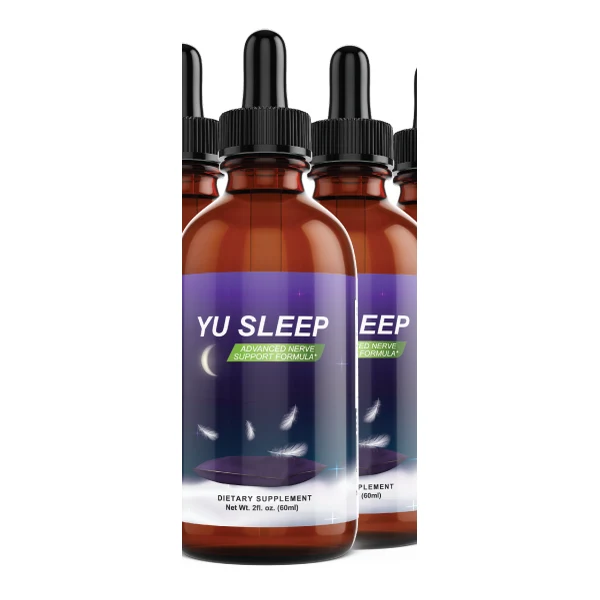
Before the ingredients, check the bottle — because there's a namesake that isn't this product. Yu Sleep is a liquid sleep supplement in an amber dropper bottle with a purple night-sky label, sold through getyusleep.com with checkout through ClickBank. One serving is 2 mL — two full droppers — taken under the tongue about 30 minutes before bed, and each bottle holds about 30 servings. The formula combines a low dose of melatonin with vitamins B2 and B6 and a blend of plant extracts and amino acids: magnesium glycinate, apigenin, L-theanine, GABA, 5-HTP, lemon balm and red tart cherry.
Before anything else, a clarification that matters: this is the liquid sleep drops formula. It is not the YuSleep melatonin spray sold on another site, which is a different product with a different formula. The two get mixed up in search results, and at least one careful review flags the mix-up explicitly. Check the bottle before you buy: amber dropper, purple night-sky label, 2 mL serving, 0.9 mg melatonin.
The pitch is a stay-asleep story: not just falling asleep, but staying asleep through the night and waking up clear. That's a different problem from most sleep supplements, which focus on falling asleep — and it's a real one: waking in the small hours and not drifting back is the problem the page is built around. The formula's best decision is the melatonin dose, and it's worth understanding why before you buy. You can see all our Sleep & Pineal reviews to stack it up against the other sleep formulas here.
Why 0.9 mg of melatonin matters
Here's the part that's actually grounded, and it's the best thing about this product. Most drugstore sleep aids contain 5 or 10 mg of melatonin — far more than your body makes in a night. That much melatonin doesn't help you sleep better; it mostly leaves you groggy the next morning. The research on melatonin consistently shows that lower doses work as well as higher ones for sleep onset, with fewer next-day effects.
Yu Sleep uses 0.9 mg — about a tenth of a typical gummy — and that's a deliberately modest dose, intended to nudge the sleep cycle without the grogginess. It's the one decision in this formula that shows someone was thinking about the evidence rather than the marketing, and it's the reason this product scores higher on ingredients than its label deserves. A low dose that works is better than a high dose that leaves you foggy.
The problem is everything around that good decision. Seven of the ten ingredients have no dose published at all, and the format itself is the constraint: two droppers of liquid, roughly 2 mL, cannot physically carry studied doses of L-theanine, magnesium, lemon balm and tart cherry on top of each other. One good decision, seven unknowns — that's the honest summary of this label.
What's inside: the ingredients
Ten ingredients, three doses you can see, seven you can't. Ten ingredients, three doses disclosed, seven hidden in a blend. Here's the honest table:
| Ingredient | Amount per 2 mL Serving | What It Does |
|---|---|---|
| Melatonin | 0.9 mg | Sleep-cycle hormone; a deliberately low dose |
| Vitamin B2 (riboflavin 5-phosphate) | 0.5 mg | Energy metabolism; supports healthy sleep-wake cycles |
| Vitamin B6 | 0.5 mg | Helps the body make serotonin and melatonin |
| Red Tart Cherry Juice Concentrate | In 637 mg blend — not disclosed | Natural source of melatonin and anthocyanins |
| Magnesium Glycinate | In 637 mg blend — not disclosed | Relaxation and muscle calm; the best-absorbed magnesium form |
| Apigenin | In 637 mg blend — not disclosed | Chamomile flavonoid that binds to calming brain receptors |
| Lemon Balm Extract | In 637 mg blend — not disclosed | Calming herb, traditionally used for restlessness |
| 5-HTP (Griffonia Seed Extract) | In 637 mg blend — not disclosed | Serotonin precursor; the one ingredient that needs a doctor's say-so |
| L-Theanine | In 637 mg blend — not disclosed | Amino acid from green tea; promotes calm without drowsiness |
| GABA | In 637 mg blend — not disclosed | Calming neurotransmitter; poorly absorbed orally, which matters |
Two honest notes. First, the disclosed doses are good: 0.9 mg of melatonin is the right call, and the B vitamins are at sensible levels. Second, the 637 mg blend is the problem: seven ingredients share 637 mg, so the average is about 91 mg each. Magnesium studies used 300 to 500 mg a day; L-theanine studies used 200 mg a day; lemon balm studies used 300 mg a day. A 2 mL serving can't hold those amounts on top of each other — the format itself is the constraint, and the blend hides the numbers so you can't check.
Stack just three of them up and the maths gets worse. Magnesium at 300 to 500 mg, L-theanine at 200 mg and lemon balm at 300 mg add up to 800 to 1,000 mg at trial doses — but the whole blend is 637 mg. Those three alone, at studied levels, would need 1.26 to 1.57 times the entire blend, before the other four ingredients get a single milligram.
Does Yu Sleep work? What the evidence says
Same split as every honest review in this category, with one twist: the ingredients have research behind them, the product itself doesn't — and the doses are the problem, because one is excellent, seven are unknown, and the format can't hold studied amounts of the rest.
The strongest ingredient evidence is for melatonin and magnesium. A 2013 meta-analysis of 19 trials found melatonin significantly reduced sleep onset time and improved sleep quality versus placebo (Ferracioli-Oda et al., 2013, PMID 23691095). A 2012 randomized trial found magnesium supplementation improved sleep time, sleep efficiency and melatonin levels in older adults with insomnia (Abbasi et al., 2012, PMID 23853635). L-theanine has a 2019 randomized trial showing it improved sleep quality and reduced stress-related symptoms (Hidese et al., 2019, PMID 31623400).
But here's the gap. Those studies used known doses of single ingredients — melatonin at 0.5 to 5 mg, magnesium at 300 to 500 mg, L-theanine at 200 mg. Yu Sleep's melatonin dose (0.9 mg) sits inside the studied range, which is genuinely good. The magnesium and L-theanine doses are hidden inside a 637 mg blend shared with five other ingredients, so they can't be at studied levels. GABA is the weakest link: it's a calming neurotransmitter, but it crosses the blood-brain barrier poorly when taken orally, so its inclusion is more marketing than mechanism. And there's no published trial of Yu Sleep itself.
So here's the honest version: a liquid sleep drop with one excellent dose decision, a well-chosen ingredient list, and seven doses you can't verify. "Fall asleep faster, stay asleep all night, wake up refreshed" is a promise the evidence doesn't support at these doses.
What results are actually realistic?
The page's pitch is falling asleep faster, staying asleep all night and waking up refreshed. That's a mix of a real hope and an overpromise, and they need separating — and no study of this product puts a week number on any of it. Here's a more honest version, built from when the ingredient research measured changes:
- First few nights: the melatonin may help you fall asleep a little faster — that's the one ingredient with a dose in the studied range, and it's the most likely to do something quickly. Any early change in staying asleep is harder to attribute, since that's the part the blend is supposed to handle.
- Weeks 2 to 4: the magnesium and L-theanine studies measured changes in sleep quality around this point, if the doses were right. If anything shifts, it's subtle — fewer 2am wake-ups, or wake-ups you drift back from more easily.
- Months 2 to 3: the page's own implied window, and the one the 60-day guarantee only just covers. If the formula is doing anything for sleep maintenance, this is when you'd expect to notice it looking back — and it's also the window the guarantee gives you to decide. Again, that's the ingredient studies' timing, not a result these drops have shown.
The line that matters most: there is no published, independent clinical trial of Yu Sleep itself. The ingredients are studied, at doses this label mostly doesn't disclose. The finished product hasn't been through that kind of testing, and no drop has been shown to fix 2am waking on its own.
How to take it
Simple routine, and the timing is the whole point of it. Two droppers (2 mL) under the tongue, about 30 minutes before bed — that's the routine. Hold the liquid under your tongue briefly before swallowing. That's the whole point of a sublingual formula — it absorbs through the mouth lining instead of going through digestion first. A bottle holds about 30 servings, so one bottle is a month of nights.
The liquid format is genuinely convenient — no pill to swallow, no water needed, and it absorbs faster than a capsule. The page names a Dr. Andrew Collins as the formulator, though I couldn't verify any credentials for that name from the sources I checked, so treat the title as marketing until proven otherwise.
One practical note: the page says to pair it with a consistent wind-down routine, and that's honest advice. No sleep supplement works well on top of a phone screen at midnight and a bedroom full of light. The drops are a nudge, not a replacement for sleep habits.
What to know before you buy
Four things on the sales page raised a flag for me. Check them before you order:
- The guarantee is thinner than it looks. It's 60 days, one-time only, and shipping and handling costs are deducted from the refund — expect about 85% back, not the full price. That's a weaker safety net than the 365-day guarantees some formulas carry, and it's worth knowing before you order twice.
- No single-bottle option. The smallest order is two bottles for $138 plus shipping. There's no way to try this for $49 or $69 — the entry price is the commitment.
- Seven of ten doses are hidden. Only melatonin, B2 and B6 have published amounts. The 637 mg blend holds seven ingredients, and a 2 mL serving can't physically carry studied doses of all of them.
- The review count doesn't add up. The official offer page shows a counter of more than 36,000 reviews with a 4.9-star average, while the brand's own shop page showed 353 reviews when one careful reviewer checked. I couldn't verify either number, so treat both as marketing, not evidence. The Better Business Bureau lists the business in Aurora, Colorado: not accredited, rated C+, with complaints on file.
To be fair, the page does a few things right: it names all ten ingredients with three real amounts, states the 60-day guarantee in plain words, charges a one-time price with no autoship, and the checkout is ClickBank, which has its own refund channel. Plenty of sales pages in this category don't manage half of that.
How much does Yu Sleep really cost?
Three packages, no single bottle, and premium per-night pricing for a blend you can't verify. Here's what they work out to, at 2 mL a night — so one bottle lasts 30 nights.
| Package | Supply | Per Bottle | Total | Per Night | Shipping |
|---|---|---|---|---|---|
| 2 bottles | 60 nights | $69 | $138 | $2.30 | Not stated as free |
| 3 bottles | 90 nights | $59 | $177 | $1.97 | Free |
| 6 bottlesBest Value | 180 nights | $49 | $294 | $1.63 | Free |
Six bottles is the cheapest per night — but it's also the biggest commitment. The honest flag here is the entry price: $138 plus shipping is the smallest order, and there's no single-bottle trial. At $2.30 a night for the smallest pack, this is premium pricing for a formula whose blend doses you can't verify. Prices are set by the seller and they can change.
The 60-day guarantee: how it works
This is the weakest part of the offer. The page promises a 60-day money-back guarantee: if you're not satisfied, request a refund through the merchant's support portal or ClickBank's order support.
Two practical details, and they matter. First, the guarantee is one-time only — it applies once per customer, so a second order after a refund never qualifies. Second, the refund policy notes that shipping and handling costs are deducted from the refund, and you pay return postage — so expect about 85% back, not the full price. You have to contact support first and wait for confirmation, then send back every bottle from the order, opened or not, to YU SLEEP, 19655 E 35th Drive, Suite 100, Aurora, CO 80011. Keep your ClickBank order number: the refund rules ask for it.
Why the window matters: sleep formulas work over weeks, not days, and the melatonin and magnesium research needs a month or more before it shows anything. A 60-day guarantee barely covers the window the formula itself needs — compare that with the 365-day guarantees some formulas carry and the gap is obvious. Sixty days is the standard for this category, but it's not generous for a sleep formula.
Yu Sleep pros and cons
- 0.9 mg melatonin — the right dose, a fraction of the groggy 5–10 mg standard
- Liquid drops absorb fast, no pill to swallow
- Well-chosen ingredient list: magnesium glycinate, L-theanine, apigenin, GABA
- One-time payment, no autoship; ClickBank checkout
- Fair per-night price on the six-bottle pack
- Three digital bonuses on the 3 and 6-bottle packs
- Seven of ten doses hidden inside a 637 mg blend
- A 2 mL serving can't hold studied doses of seven blend ingredients
- No single-bottle option — $138 minimum order
- Guarantee is one-time only, with shipping deducted from refunds
- Review count doesn't add up: 36,000 claimed vs 353 on the shop page
- BBB rating C+, not accredited, with complaints on file
- No trial of the product itself; research cited is on ingredients in general
Who should consider it, and who should skip it
- You fall asleep fine but wake at 2 or 3am and can't drift back off
- You want a low melatonin dose that won't leave you groggy
- You prefer liquid drops to capsules and you'll pair them with a wind-down routine
- You take antidepressants — 5-HTP needs a doctor's say-so first
- You take sedatives or blood pressure medication — ask your doctor first
- You want studied doses — seven of ten are hidden in a blend
- Your insomnia is persistent or worsening — see a doctor, not a supplement page
- You're pregnant, nursing, under 18 or on medication, unless a doctor says otherwise
Safety: what to check before you start
The ingredients are familiar, but one of them needs a proper warning before anything else. For most healthy adults, these are familiar ingredients — melatonin, magnesium, L-theanine and lemon balm are all things you'd find in food and standard sleep supplements. No stimulants, nothing habit-forming. The side effects that come up most with this kind of blend are morning grogginess (less likely at 0.9 mg than at 5 mg, but still possible) and vivid dreams, which melatonin can cause in some people.
The cautions that actually matter:
- Antidepressants — read this one twice. 5-HTP is a serotonin precursor, and combining it with antidepressants (especially SSRIs) can raise serotonin too high — a condition called serotonin syndrome, which is serious. If you take any antidepressant, ask your doctor before taking Yu Sleep. This is the one ingredient here that truly needs that conversation.
- Sedatives and blood pressure medication: melatonin, GABA and lemon balm all add to drowsiness, and magnesium can lower blood pressure. If you take sedatives or blood pressure drugs, ask your clinician first.
- Driving and machinery: don't drive or operate machinery after taking Yu Sleep. That's obvious advice, but it's worth saying plainly for a product designed to make you sleepy.
- Persistent insomnia: if your sleep problems are new, worsening, or accompanied by snoring, gasping or daytime sleepiness, see a doctor. Sleep apnoea and other sleep disorders need evaluation, not a dropper.
Talk to your doctor or pharmacist before starting, especially if you take any medication. And if you notice a new symptom after starting any supplement, stop and get medical advice. Simple as that.
Yu Sleep FAQ
Is Yu Sleep a scam? –
No — based on what I checked, it's a real product with a working ClickBank checkout, ten named ingredients and a stated 60-day refund. My concerns are about the hidden blend doses, the $138 minimum order and the one-time guarantee, not about whether you can actually buy it.
Does Yu Sleep work? +
I can't say it does. Melatonin at 0.9 mg sits inside the studied range, and magnesium and L-theanine have real research behind them — but there's no trial of Yu Sleep itself, and seven of its ten doses are hidden inside a 637 mg blend.
What are the Yu Sleep ingredients? +
Ten in total: melatonin 0.9 mg, vitamin B2 0.5 mg, vitamin B6 0.5 mg, and a 637 mg proprietary blend of red tart cherry juice concentrate, magnesium glycinate, apigenin, lemon balm extract, 5-HTP, L-theanine and GABA. Individual blend amounts are not published.
How much does Yu Sleep cost? +
$138 for 2 bottles ($69 a bottle) plus shipping, $177 for 3 ($59 a bottle) and $294 for 6 ($49 a bottle), with free shipping on the bigger packs. There's no single-bottle option. Prices were checked in November 2026 and they can change.
How do you take Yu Sleep? +
Two droppers (2 mL) under the tongue, about 30 minutes before bed. A bottle holds about 30 servings, a month of nights. It's a liquid, not the YuSleep melatonin spray sold elsewhere.
Is there a Yu Sleep refund policy? +
Yes — a 60-day money-back guarantee. It's one-time only, shipping and handling are deducted from the refund — expect about 85% back, not the full price — and you pay return postage. You have to contact support first and wait for confirmation, then send back every bottle from the order, opened or not. Keep your ClickBank order number: the refund rules ask for it.
Is Yu Sleep safe? +
The ingredients are familiar — but 5-HTP is a serotonin precursor, so if you take antidepressants, ask your doctor first: combining them can raise serotonin too high. And if you take sedatives or blood pressure medication, check with a doctor first.
Where can I buy Yu Sleep? +
Directly from the official site — it's sold online only, and ClickBank is the checkout. That's how to reach the current price and the stated guarantee. Check the bottle: amber dropper, purple night-sky label, 2 mL serving.
Final verdict: is Yu Sleep worth it?
Who should buy it: someone who falls asleep fine but wakes at 2 or 3am, wants a low melatonin dose that won't leave them groggy, and prefers liquid drops they'll pair with a wind-down routine. Who should skip it: anyone on antidepressants — 5-HTP needs a doctor's say-so first — anyone who wants studied doses, because seven of ten are hidden in the blend, and anyone whose insomnia is persistent or worsening, because that's a doctor's visit, not a dropper.
My take: the 3.3 rests on one decision and one list. The 0.9 mg melatonin dose is the best call in the formula — a fraction of the groggy 5–10 mg standard — and the ingredient list is well chosen, which is why Ingredients scores 3.5. What costs it the rest is the label: seven of ten doses hidden, a 637 mg blend that can't hold studied amounts, and a one-time-only guarantee with shipping deducted. The 2-bottle pack is the only way in — just know the guarantee won't cover a second order. And if you take antidepressants, ask your doctor first: 5-HTP is the one ingredient here that genuinely needs that conversation.
Final score = weighted average of the five categories above. Full method on our How We Review page.
Get Today's Price on the Official Site →How I checked this: official Yu Sleep sales page (getyusleep.com) and corroborating label reviews for the 0.9 mg melatonin, the 637 mg proprietary blend, the $138/$177/$294 pricing, the 2-bottle minimum and the 60-day one-time guarantee; published research on melatonin, magnesium and L-theanine as individual ingredients. Sources: How We Review · Affiliate Disclosure
This article is for general information only and is not medical advice. Talk to your own doctor about supplements, especially if you take antidepressants, sedatives or blood pressure medication, or have a sleep disorder — and get persistent insomnia checked by a doctor, because it can be a symptom of something serious. This article contains affiliate links — we may earn a commission if you buy through them, at no extra cost to you. It doesn't change what we write; the cons section above should make that clear.