 Anxiety Remedy
Brain & Memory · Program Review
The Memory Wave Reviews: 12 Minutes of 40 Hz
 90-Day Money-Back Guarantee via ClickBank
Verdict: buyers split exactly the way the research predicts — some report easier recall after weeks, others report nothing at all. Twelve minutes a day, headphones on, a gamma-frequency track at around 40 Hz, built on a real piece of MIT research, for $39 once. The sales copy is calmer than its siblings: it talks about gradual effects over weeks, not miracles, and its own disclaimers draw the line at medical treatment. The seller claims 4.9 out of 5 from 6,954 reviews, but I could not verify that number anywhere independent. What does not change is the gap at the centre: the 40 Hz research was done on mice with light and sound, not on people with an MP3, and this specific track has never been tested in a published trial.
Get Today's Price on the Official Site →Prices checked November 2026 · $39 one-time; some sources report a 60-day window instead of 90 — see the guarantee section.
What customers say
What were buyers saying in the write-ups I could track down? The consistent thread is the split the research predicts: some listeners report slightly easier recall and less fog after weeks of daily listening, others report nothing at all, and the honest reviews stress that the gamma research is real but the product itself is untested. The page's own testimonials are hand-picked, as usual for this category. What would settle it is a real buyer pool with a published average and a breakdown. Until that exists, the buyer evidence for The Memory Wave is a seller-claimed 4.9 and a handful of stories the seller chose.
The quick take
- What it is: a digital audio program — one 12-minute gamma-frequency track at around 40 Hz, listened to daily through stereo headphones, plus a PDF guide and three digital bonuses. No pills, no device, no subscription.
- What it costs: $39 one-time, every source agrees. No bundles, no renewal, nothing else to buy.
- The mechanism: gamma brainwave entrainment at 40 Hz, the frequency MIT researchers used to reduce amyloid in Alzheimer's-model mice. The mouse research is genuine; the leap to a consumer MP3 is untested.
- The guarantee: A 90-day money-back window, refunded through ClickBank. Some sources report 60 days instead, so confirm the window at checkout.
- My take: the most honestly sold audio in this category, and the cheapest risk. The science underneath is real. The product itself is an untested stretch of that science.
My rating is
Best for: curious listeners with everyday forgetfulness who want a low-cost, no-pill routine and understand that the evidence is about a method in mice, not this file in people.
What is The Memory Wave?
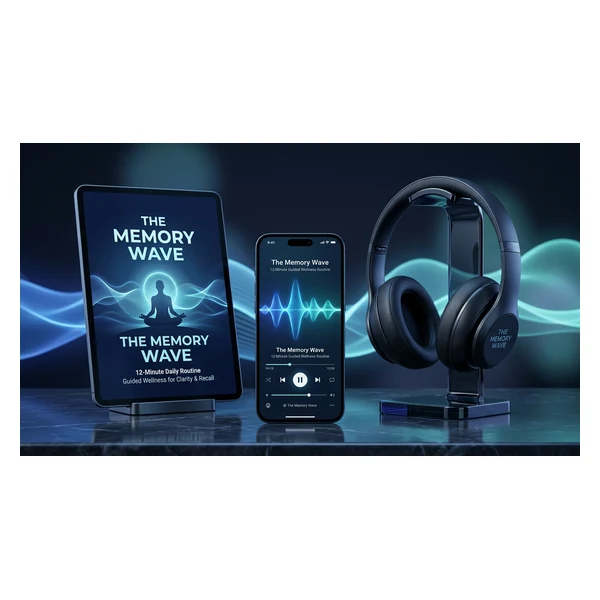
The Memory Wave is a digital audio program built around one focused, twelve-minute daily session — a gamma-frequency track at around 40 Hz that you listen to through stereo headphones, aimed at memory, focus and mental clarity. Twelve minutes is longer than its siblings, and that extra time is part of the decision. The program is positioned as a general wellness resource, not as medical care and not as a substitute for prescribed medication, diagnosis or professional treatment. That framing matters, because it is more honest than most of the category — and this review gives it credit for that.
The track is credited to Dr. James Rivers, and the vendor discloses that the name is a professional pen name used to protect the real expert's privacy. That disclosure is more upfront than most of these personas, and it is worth saying so. It still means there is no publicly verifiable researcher behind the product — no trackable academic footprint, no published papers, no institutional profile. A disclosed pen name is better than an undisclosed one. It is not a substitute for a verifiable expert.
The program is sold through ClickBank, which handles the payment and the refund, and delivery is instant and digital: audio files and PDFs, nothing ships, nothing gets installed. The package is a single 12-minute track, a PDF guide, and three digital bonus downloads. The sales copy pitches gradual effects over weeks rather than days, and it skips the one-click-miracle framing that plagues this category. That restraint is the product's best feature, and it is the reason this page scores it higher than its louder siblings.
One confusion to clear up first, because the names invite it: The Memory Wave is not Genius Song and it is not The Genius Wave. All three are $39 audio programs sold through ClickBank. The Memory Wave is the twelve-minute gamma track. Genius Song is a seven-minute gamma track. The Genius Wave is a seven-minute theta track. This page is about The Memory Wave only, and I have kept the three apart on purpose — mixing them up is the easiest mistake in this category.
Why 40 Hz gamma
Gamma is the fastest brainwave band, roughly 30 to 100 Hz, and 40 Hz sits in the middle of it. In the research literature, gamma activity is linked with memory, learning and attention — the brain's fast rhythm for binding information together. That is the science the product borrows; the next paragraph is what it leaves out. The specific 40 Hz figure comes from a real and serious line of research at MIT, and it is worth understanding what that research actually did before any product claims to borrow it.
That gap is the whole story of this product. The hook is real science. The leap is the vendor's. The research used different delivery, different doses and different subjects, and the human trials that followed have been thin — a six-month feasibility trial (OVERTURE, 76 people) met its safety/tolerability outcomes but found no separation from sham on its main efficacy measures, and a larger 673-person pivotal trial completed in August 2026 with no published topline results as of late 2026. A twelve-minute consumer audio file is a long way from a laboratory flicker regime, and nobody has run a controlled trial on this specific file to close that distance.
What's inside the package
No ingredients, no label — this is an audio program, so here is what the purchase actually contains, as described on the official page and in corroborating reviews:
| Component | What It Is | What It Does |
|---|---|---|
| Main audio track | Digital audio file | 12-minute gamma-frequency track at around 40 Hz, for daily headphone listening |
| PDF guide | Listening guide | Setup guidance and the concise listening routine |
| Three bonus downloads | Digital extras | Three bonus guides included with the program |
| Delivery | Email download | Instant digital access; no shipping, no physical product |
| Session length | 12 minutes | One track, once a day, through stereo headphones |
| Equipment needed | Headphones | Stereo headphones required; the effect depends on a different tone in each ear |
What the package does not contain is any coaching, any app, any community, or any measurement of your brain. You get an audio file and some PDFs. Whether the file does anything to your memory is something you judge yourself, over weeks, with no instrument except your own sense of how the day went. That is the deal, and it is worth stating plainly because even the most honest marketing in this category still sells a twelve-minute sound file as a memory intervention.
How you use it
The routine is the easy part: no pill, no dose, no set time of day. Twelve minutes once a day with stereo headphones, whenever it fits — headphones on, press play, hear the whole track through, then get on with your day. The sales copy pitches gradual effects over weeks rather than days, and that timeline is the honest one: if the track does anything, it will show up as a slow drift in how your days feel, not as a moment of clarity on day one.
A speaker will not do it. The beat needs a different tone in each ear, which is why stereo headphones are part of the product, not an accessory. The file plays on any phone or computer with nothing to install. Twelve minutes is longer than the seven-minute tracks in this category, and that extra time is a real consideration: a routine you will not keep is a routine that cannot work, so pick a slot in the day that actually exists — the morning coffee, the lunch break, the evening wind-down — and anchor the track to it.
Does The Memory Wave work? What the evidence says
Three things, kept apart: the research underneath it is real and serious, this track has not been tested, and the leap from mice to MP3 is the vendor's, not the science's.
Start with the research, because it deserves respect. In 2016, Iaccarino and colleagues at MIT showed that driving fast-spiking interneurons at 40 Hz reduced amyloid-beta levels in Alzheimer's-model mice, and that a non-invasive 40 Hz light-flicker regime reduced amyloid in the visual cortex and mitigated plaque load in aged mice (Iaccarino et al., Nature 2016; PMID 27929004). In 2019, Martorell and colleagues extended it: 40 Hz sound stimulation improved spatial and recognition memory and reduced amyloid in the same mouse models, and combining 40 Hz sound with 40 Hz light reduced amyloid in the medial prefrontal cortex and produced widespread plaque reduction (Martorell et al., Cell 2019; PMID 30879788). That is the science the product points at, and it is genuine.
Now the caveats, because they are as important as the findings. The research was done on mice, not people. It used light flicker and sound delivered in a lab for about an hour a day, not a twelve-minute headphone track. Two independent labs could not reproduce the amyloid effect using the same mouse models — Soula et al. (Nature Neuroscience, 2023) found no entrainment of native gamma and no reduction in amyloid-beta 40/42 in APP/PS1 and 5xFAD mice, and Yang & Lai (eNeuro, 2023) found five weeks of daily 40 Hz flicker did not reduce amyloid load in 5xFAD mice. The originating Tsai lab disputes the Soula result, so the mouse literature is contested rather than settled. The human work is thin — the largest published human trial missed its main efficacy outcome, and the 673-person pivotal trial completed in August 2026 with no results posted as of late 2026. The preclinical work is elegant and contested, and the human work is, where it is best controlled, negative on cognition.
There is a second line of evidence worth stating fairly. A 2019 meta-analysis by Garcia-Argibay and colleagues pooled 22 studies of binaural beats and found a medium overall effect — Hedges' g = 0.45 — across cognition, anxiety and pain perception (Garcia-Argibay et al., Psychological Research 2019; PMID 30073406). That is a real, peer-reviewed result about the method in general. It is not a test of this track, and it is not a promise that twelve minutes of gamma audio improves anyone's memory. The honest sentence is: the 40 Hz method is real, the mouse results are real and contested, the human results are thin, and this specific file has never been tested at all.
What results are actually realistic?
The marketing is calmer than its siblings, and the honest timeline is calmer still — here is what a fair test looks like, week by week:
- First couple of weeks: usually nothing measurable. You may feel calmer or more settled after listening — twelve quiet minutes with headphones is relaxing on its own, with or without any entrainment. Do not mistake relaxation for a memory gain.
- Weeks 3 to 6: this is where listeners who liked the program say they noticed slightly easier recall and less mental fog. If it is going to do anything for you, this is the window — and it is also the window where better sleep, a new routine or a placebo effect would show up the same way.
- Days 60 to 90: the honest test, and the window the guarantee covers. If your everyday forgetfulness is genuinely easier by now — fewer lost keys, fewer blank names — keep the routine. If nothing has changed, more of the same track is unlikely to change the story.
One line that belongs in every review of this product: there is no published trial of The Memory Wave itself. The 40 Hz research is real and serious, and it was done on mice with light and sound. Whether a consumer MP3 reproduces any of it in humans is untested — at least, I could not find a single study that tries.
What to know before you buy
Four things I would check before the $39 leaves my account:
- Mice are not people. The 40 Hz research was done on Alzheimer's-model mice with an hour a day of lab-delivered light and sound. A twelve-minute headphone track is a different delivery, a different dose and a different species. The leap is the vendor's.
- The human trials are thin. The largest published human trial missed its main efficacy outcome — OVERTURE (76 people, six months, sham-controlled) found no separation from sham on its MADCOMS composite, CDR-SB or ADAS-Cog14 — and the 673-person pivotal trial completed in August 2026 with no published results as of late 2026. The human evidence does not support the product — it has not caught up with the mouse work.
- The guarantee has two numbers. The official page states 90 days, and some sources report 60. Settle it at checkout — screenshot the refund wording when you order.
- Lookalike domains sell this product. Multiple lookalike domains sell audio programs under similar names. Buy through the official page and check the vendor name, or you may pay for the wrong track.
How much does The Memory Wave really cost?
$39, once, and no tiers to decode — here is the honest maths:
| Item | Cost | Notes |
|---|---|---|
| The Memory Wave audio program | $39 | One-time payment, no subscription |
| PDF guide + 3 bonus downloads | Included | Listening guide and three bonus guides |
| Headphones | You own them | Stereo headphones required; not included |
| Total to start listening | $39 | Nothing else to buy |
Every source I checked agrees on $39 — rare in this category, and worth noting. Ninety days of daily listening is 18 hours of audio (90 × 12 minutes) for $39 — about $2.17 an hour, or 43 cents a session. The page shows a "today only" framing, a marketing device; the price people actually pay is $39. There are no bundles and no alternative packages. The seller controls the price and can change it, so confirm the total at checkout. Expect an upsell sequence immediately after purchase — decline what you do not want.
The 90-day guarantee: how it works
The Memory Wave is advertised with a 90-day, 100% money-back guarantee — during that period you can access the program, examine the supporting downloads, and decide whether the overall package meets your expectations. Refunds are handled by ClickBank, which is the reliable part of this transaction: keep your order number, because that is what ClickBank will ask for.
The wrinkle is that some sources report a 60-day window instead. One detailed review advises planning around 60 days to be safe, even though the official page states 90. Only the checkout page settles it, so screenshot the guarantee wording when you order and keep your order confirmation. Ninety days covers two months of daily listening with time to judge the routine. Sixty would still cover a fair test, just barely.
Worth knowing: the guarantee covers the $39 program, and there is nothing physical to send back — no bottle, no device — so claiming the refund means asking, not shipping. That is what makes the window genuinely usable, and it is the main reason this product scores as well as it does despite the thin evidence.
The Memory Wave pros and cons
- $39 one-time — the cheapest experiment in this category
- 90-day refund through ClickBank, a real refund path
- Most honestly framed audio in this category — gradual effects, clear disclaimers
- The 40 Hz research underneath is real, published MIT science
- Twelve minutes a day, no pills, no side effects, no habit to build
- One-time payment, no subscription
- No trial of this track itself — evidence is about mice, not this file
- Human 40 Hz trials are thin, and the largest missed its main efficacy outcome
- Creator is a disclosed pen name with no verifiable background
- Guarantee reported as both 90 and 60 days
- 4.9/5 from 6,954 reviews is a seller claim, not a verified pool
- Lookalike domains sell similar programs under similar names
Who should consider it, and who should skip it
- You have everyday forgetfulness and want a low-cost, no-pill routine
- You understand the evidence is about a method in mice, not this file in people
- You will judge it after 60 to 90 days and use the refund if nothing changes
- You have epilepsy or a history of seizures — avoid brainwave entrainment audio entirely
- You want a treatment for Alzheimer's, dementia or ADHD — this is wellness audio, not medicine
- You expect results in a few days — the product itself pitches weeks, not days
- You need a settled refund window in writing before you buy
Safety: what to check before you start
Twelve minutes of audio through headphones carries almost no physical risk for most healthy adults — nothing swallowed, nothing interacting with medication, no stimulant. Short section, but two of its three items are serious in different ways.
What to watch for:
- Epilepsy and seizures: rhythmic sound stimulation can trigger a seizure, and the standard advice is for people with epilepsy or a seizure history to avoid brainwave entrainment audio completely. If that is your history, this product is not for you at any price.
- Volume: twelve minutes a day at an ordinary volume is fine. Resist turning it up to catch the beat — it is designed to sit quietly under the music, and loud headphones are the one real hearing risk in this product.
- A diagnosed memory condition: this is wellness audio, not treatment. If you have Alzheimer's, dementia or another diagnosed condition, talk to your doctor first — and do not let a $39 track delay real care.
Check with a doctor first if you have a neurological or hearing condition, or anything else rhythmic sound might affect. Stop listening and seek medical advice if anything feels wrong.
The Memory Wave FAQ
Is The Memory Wave a scam? –
No — based on what I checked, it is a real digital audio program sold through ClickBank with a refund policy, and the 40 Hz research it points at is genuine. What is oversold is the leap from that research to this specific file, which has never been tested.
Does The Memory Wave work? +
I cannot say it does. The MIT mouse research on 40 Hz stimulation is real, but it used light and sound in a lab, not a twelve-minute MP3, and no trial has tested this track in humans. The human 40 Hz trials so far are thin.
What is The Memory Wave, exactly? +
A digital audio program: one 12-minute gamma-frequency track at around 40 Hz, listened to daily through stereo headphones, plus a PDF guide and three bonus downloads. It is sold through ClickBank, and delivery is by email download.
How much does The Memory Wave cost? +
$39 one-time, every source agrees. No subscription, no bundles. Prices were checked in November 2026 and they can change. Expect an upsell sequence after purchase — decline what you do not want.
How do you use The Memory Wave? +
Twelve minutes a day, headphones on, once a day. A speaker will not work — the beat needs a different tone in each ear. The program pitches gradual effects over weeks, not days.
Is there a Memory Wave refund policy? +
Yes — a 90-day, 100% money-back guarantee, according to the official page. Some sources report 60 days instead, so confirm the window on the checkout page and keep your order number.
Is The Memory Wave safe? +
For most healthy adults, yes — it is twelve minutes of audio, not a pill. The serious exception: people with epilepsy or a history of seizures should stay away from brainwave entrainment audio completely. And it is not a treatment for any diagnosed condition.
How is The Memory Wave different from Genius Song? +
The Memory Wave is a twelve-minute gamma track. Genius Song is a seven-minute gamma track. The Genius Wave is a seven-minute theta track. Three different $39 programs — check the name and the track length before you buy.
Final verdict: is The Memory Wave worth it?
The 3.5 is the highest score in this audio group, and it earns it the same way it loses points: on honesty. In its favour: $39 once, twelve minutes a day, the most restrained marketing of the three audio programs, a real 90-day ClickBank refund, and genuine MIT research underneath. Against it: the research was done on mice with lab-delivered light and sound, the human trials are thin, and this specific track has never been tested. It is the best-framed experiment in the category — and still an experiment.
My take: if you have everyday forgetfulness and you want the lowest-risk experiment in this category, the $39 is a fair price for the track — but only if you judge it after 60 to 90 days of daily listening and use the refund if nothing has changed. If you have a diagnosed memory condition, talk to your doctor first: this is wellness audio, not treatment, and it should never delay real care.
Final score = weighted average of the five categories above. Full method on our How We Review page.
Get Today's Price on the Official Site →How I checked this: corroborating reviews of The Memory Wave offer ($39 price, 12-minute session, 90-day guarantee, three bonus guides, Dr. James Rivers pen name); the 40 Hz gamma research (Iaccarino et al., Nature 2016, PMID 27929004; Martorell et al., Cell 2019, PMID 30879788); the binaural-beats meta-analysis (Garcia-Argibay et al., Psychological Research 2019, PMID 30073406); the human 40 Hz trial record, including the HOPE pivotal trial (NCT05637801; 673 participants enrolled, completed 17 August 2026, no results posted on ClinicalTrials.gov and no published topline as of late 2026), and the failed-replication papers (Soula et al., Nature Neuroscience 2023, DOI 10.1038/s41593-023-01270-2; Yang & Lai, eNeuro 2023, DOI 10.1523/ENEURO.0189-23.2023). Sources: How We Review · Affiliate Disclosure
This article is for general information only and is not medical advice. Epilepsy or a history of seizures means staying away from brainwave entrainment audio. This is not a treatment for Alzheimer's, dementia, ADHD or any diagnosed condition — talk to your own doctor about memory concerns. This article contains affiliate links — we may earn a commission if you buy through them, at no extra cost to you. It doesn't influence what we write; the cons section above should make that clear.