 Anxiety Remedy
Women's Health · Supplement Review
FemiCore Reviews: Cranberry, Probiotics & Hidden Doses
 60-Day Money-Back Guarantee
Verdict: a sensible idea, hidden doses FemiCore is a genuine supplement with a ClickBank checkout, nine named ingredients and a 60-day refund that covers opened bottles. The idea behind it is sound — cranberry and five Lactobacillus strains aimed at bladder and urinary health, one capsule a day. But the label hides every individual dose and the probiotic count, there's no trial of the finished formula, and the sales page can't show me a single verifiable buyer review. Buy it for the cranberry-probiotic idea and the refund window, not for any promise of leak-free living.
Get Today's Price on the Official Site →Prices checked November 2026 · 60-day guarantee; opened bottles accepted.
The quick take
- What it is: a once-daily women's bladder and urinary-health capsule — four botanicals plus five Lactobacillus probiotic strains, 30 capsules a bottle.
- What it costs: $79 a bottle for two ($158), $69 a bottle for three ($207), $49 a bottle for six ($294). The two-bottle pack adds $9.99 US shipping; the bigger packs ship free in the US.
- The label: nine ingredients named, grouped into a 350 mg herbal blend and a 50 mg probiotic blend. No individual dose is published, and no CFU count for the probiotics.
- The guarantee: 60 days, money back, opened or empty bottles accepted. ClickBank is the retailer of record and handles refunds.
- My take: the cranberry-plus-L.-crispatus idea has real science behind it for urinary health — but nothing here proves it stops leaks or urgency, and that's the gap that decides the score. A fair try if your doctor agrees — and keep the refund window in mind.
My rating is
Best for: women looking for a cranberry-and-probiotic approach to urinary health who want a real refund window and a simple one-capsule routine.
What is FemiCore?
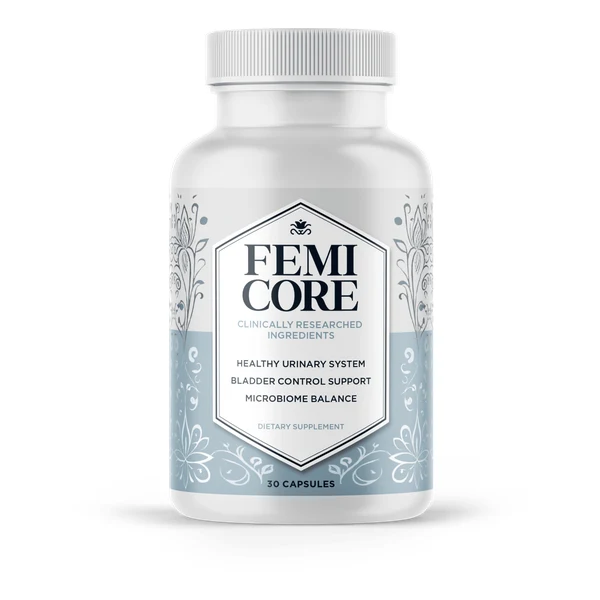
One capsule, two halves, and a promise the evidence only half supports. FemiCore is a dietary supplement sold to women for bladder control, urinary health and microbiome balance. One capsule a day, 30 capsules a bottle, so a bottle is a month. The formula has two halves: a 350 mg herbal blend of mimosa pudica seed extract, cranberry extract, bearberry leaf and granular berberine, and a 50 mg probiotic blend of five Lactobacillus strains — crispatus, acidophilus, plantarum, gasseri and casei.
The pitch is that bladder leaks and urgency come partly from an unhappy urinary microbiome, and that feeding the right bacteria while adding cranberry and traditional bladder herbs can steady things. It's sold only through the official FemiCore website, with ClickBank as the retailer of record — the same setup as a dozen other supplement brands. ClickBank handles order questions on 1-800-390-6035.
One thing to get straight before anything else: FemiCore is a supplement, not a medicine. It hasn't been evaluated by the FDA to treat or prevent any condition, and it isn't a substitute for seeing a doctor about leaks, urgency or recurrent infections. If you're dealing with any of those, a clinician should be your first stop, not a capsule.
Why bladder health gets so much attention
Here's why this product sells before anyone reads the label. Bladder leaks and urgency are far more common than most women talk about — they show up after childbirth, around menopause, and simply with age, as pelvic floor muscles weaken and hormone levels shift. It's an awkward subject, which is exactly why it sells so well online: nobody wants to bring it up at the doctor's, so a private one-capsule fix sounds appealing.
There's a real thread of science in the pitch. The urinary tract has its own microbiome, and Lactobacillus crispatus is the dominant species in a healthy one. Cranberry has the best-studied track record of any ingredient here — but for preventing urinary tract infections, not for stopping leaks. The leap from "supports urinary health" to "fixes bladder control" is where the marketing runs ahead of the research, and I'll keep pulling that thread apart through the rest of this review.
Does FemiCore work? What the evidence says
Blunt answer, and it's the split that decides this review: the ingredients have research behind them, the product itself doesn't — and the strongest evidence points at a different job than the one the sales page leads with.
Cranberry is the best case in the bottle. A Cochrane review from 2012 pooled the trials and found cranberry products cut the risk of urinary tract infections, particularly recurrent ones. That's prevention of infections — not bladder control, not leaks, not urgency. Worth knowing, and worth not overstating.
Berberine's research is mostly metabolic. A 2008 pilot study found it lowered blood sugar in people with type 2 diabetes, and later reviews back that up. But blood sugar isn't bladder control, and I found no trial testing berberine for leaks or urgency. It's a reasonable ingredient in a general wellness formula; it's not a bladder ingredient with proof.
The probiotic side is plausible but unproven for this job. L. crispatus really is the dominant species in a healthy vaginal microbiome, and probiotic trials have tested it for vaginal health — the National Center for Complementary and Integrative Health has a good plain-language summary of where probiotic evidence actually stands. But no published trial has tested this five-strain blend for bladder leaks, and the 50 mg blend total gives no CFU figure to compare against the doses used in trials.
Mimosa pudica is the weakest link. It's used in traditional medicine, and a review of the plant found no quality-controlled human trials — mostly lab and animal work. Bearberry has traditional use for urinary complaints, but again, no modern trial of the kind you'd want before spending $79 a bottle. So here's the honest version: a coherent cranberry-plus-probiotic idea with no trial of its own, and no ingredient evidence showing help for bladder control or leaks.
What's inside: the ingredients
Nine names, two blend totals, and not one amount you can check. Nine ingredients, named on the label — and not one individual amount published. Here's the honest table:
| Ingredient | Amount per Serving | What It Does |
|---|---|---|
| Mimosa pudica seed extract | In the 350 mg blend, not stated | Traditional Ayurvedic plant; the page links it to gut and urinary balance |
| Cranberry extract (30% PAC) | In the 350 mg blend, not stated | Proanthocyanidins; best-studied ingredient here, for UTI prevention |
| Bearberry leaf (uva ursi) | In the 350 mg blend, not stated | Traditional urinary herb; contains arbutin, which needs short-term use only |
| Granular berberine (8% berberine HCl) | In the 350 mg blend, not stated | Plant compound with metabolic research; no bladder-specific trials |
| Lactobacillus crispatus (LCr86) | In the 50 mg blend, no CFU stated | Dominant species in a healthy vaginal and urinary microbiome |
| Lactobacillus acidophilus (LA88) | In the 50 mg blend, no CFU stated | Well-known probiotic strain for gut and vaginal flora |
| Lactobacillus plantarum (N13) | In the 50 mg blend, no CFU stated | Probiotic strain studied for gut and immune support |
| Lactobacillus gasseri (LG08) | In the 50 mg blend, no CFU stated | Probiotic strain found in healthy vaginal flora |
| Lactobacillus casei (LC16) | In the 50 mg blend, no CFU stated | Probiotic strain with gut-health research behind it |
Two honest notes. First, the blend totals are real — 350 mg of herbs and 50 mg of probiotics — but a probiotic blend measured in milligrams without a CFU count tells you almost nothing about potency. CFU is the number that matters for probiotics, and it isn't published anywhere. Second, bearberry deserves a flag: its active compound arbutin converts to hydroquinone in the body, and traditional guidance is short-term use only. The page doesn't say how much bearberry is in a capsule, so I can't judge the exposure — and neither can you.
One more way to read the two blends: they total 400 mg per capsule, and the probiotic half is 50 mg of it — one-eighth. Five strains share that 50 mg, so 10 mg each if split evenly, and milligrams still say nothing about potency: a probiotic dose is measured in CFU, and no CFU figure is published anywhere. The 350 mg herbal half is seven-eighths of the capsule, and cranberry is only one of its four ingredients.
How to take it (and what it tastes like)
Dead simple, which is half the appeal. One capsule a day, with water — that's the whole routine. A bottle holds 30 capsules, so one bottle is a month exactly. Take it at the same time each day so you don't forget it; probiotics are a habit game, and a missed week here and there won't tell you anything.
They're swallowed capsules, so there's no taste to report. The official page says to take one capsule every morning with a big glass of water — it doesn't say whether to take it with food, so follow the morning-and-water direction. If you take antibiotics, space the capsule a couple of hours away from the dose; that's standard probiotic advice, and it's worth following even though the page doesn't say it.
How much does FemiCore really cost?
No single bottle on the page I checked — three packs, and the cheapest way in is still $158. The official offer page lists three packs. Here's what they work out to, at one capsule a day, so one bottle lasts 30 days.
| Package | Supply | Per Bottle | Total | Per Day | Shipping |
|---|---|---|---|---|---|
| 2 bottles | 60 days | $79 | $158 | $2.63 | +$9.99 (US) |
| 3 bottles | 90 days | $69 | $207 | $2.30 | Free (US) |
| 6 bottlesBest Value | 180 days | $49 | $294 | $1.63 | Free (US) |
Six bottles is the cheapest per day — but it's also a six-month commitment against a 60-day guarantee, so the 3-bottle pack is the lower-risk way to test it. The 6-bottle pack adds three digital bonus guides. UK orders pay $15.95 shipping. Prices are set by the seller and they can change — and some sources report a single bottle at $69, which I could not verify on the official page.
What results are actually realistic?
The sales page talks about bladder control and leaks as if a capsule can sort them in weeks. That's the overpromise to unpick — and no study of this product puts a week number on any of it. Here's a more honest version, based on what the ingredients can actually do:
- First couple of weeks: usually nothing obvious. Probiotics take time to shift anything, and cranberry doesn't work overnight. Mostly you're just building the habit.
- Weeks 4 to 8: probiotic trials measured small shifts in flora around this point. If anything changes, it's subtle — and for leaks specifically, pelvic floor exercises have far better evidence than any capsule.
- Months 2 to 3: that's the window where you'd judge it. Cranberry's UTI-prevention evidence builds over months of daily use, not days. If you're prone to recurrent UTIs, this is the benefit with the most support — not leak control. Again, that's the ingredient evidence's timing, not a result this capsule has shown.
The line that matters most: there is no published clinical trial of FemiCore itself. The ingredients are studied for other jobs. The finished product hasn't been tested for bladder control, and no capsule replaces pelvic floor training or a doctor's assessment of urgency and leaks.
What to know before you buy
Four things stood out on the sales page, and none of them is good news. Check them before you order:
- Leaks are the lead claim, but the evidence is for UTIs. Cranberry's best research is UTI prevention. Nothing in the bottle has trial evidence for bladder control or leaks. The page leans on the leak story because that's what sells.
- No CFU count anywhere. A probiotic blend measured in milligrams without a colony-forming-unit count is a label that doesn't tell you the dose. Every serious probiotic brand prints CFU. This one doesn't.
- Bearberry needs a caution the page skips. Arbutin converts to hydroquinone, and traditional guidance is short-term use only. With no dose published, you can't check your exposure.
- Price confusion. The official offer page lists 2, 3 and 6-bottle packs ($158, $207, $294). Some review sites report a single bottle at $69 — I couldn't verify that on the official page, so treat the 2-bottle pack at $79 a bottle as the real starting point and confirm at checkout.
To be fair, the page does a few things right: it names all nine ingredients, states the 60-day guarantee in plain words, says it's a one-time payment with no autoship, and ClickBank as retailer means refunds go through an established processor with its own support line. Most sales pages don't manage that much.
The 60-day guarantee: how it works
The guarantee is the most generous part of this offer, and it's worth reading properly. FemiCore comes with a 60-day money-back guarantee. If you're not happy, you can return all bottles — opened or empty — with the packing slip for a full refund. ClickBank is the retailer of record, so the refund runs through ClickBank's system, and returns go to the vendor's address in Tallmadge, Ohio.
One practical detail: the guarantee runs 60 days — the official page says 'try FemiCore for a full 60 days', and one label transcription says from purchase. Keep your order confirmation and the packing slip — ClickBank refunds need the order details, and the vendor asks for the slip with returns.
Why the window matters: a 6-bottle pack is six months' worth, so the guarantee covers just the first third of it. That's normal for this category, but it means the big pack is a bet you place after the refund window closes. If you're on the fence, the 3-bottle pack keeps most of your order inside the guarantee.
What customers say
That's a real gap. A product that's been selling for a while should have some trace of buyers somewhere — a Trustpilot page, a Reddit thread, a forum mention. FemiCore has none I could verify. The absence doesn't prove the product is bad; it proves you can't lean on other buyers' experience before you spend your money. You're buying on the strength of the ingredient list and the refund window, and that's all there is.
FemiCore pros and cons
- Cranberry and L. crispatus are a coherent pair for urinary health, with real research behind both
- Simple routine: one capsule a day, no mixing or drops
- 60-day guarantee covers opened or empty bottles
- ClickBank as retailer — refunds run through an established processor
- One-time payment, no autoship; US shipping free on the 3 and 6-bottle packs
- Seller states made in the USA in a GMP-certified, FDA-registered facility (not verified on the official page)
- No individual ingredient dose published — blends only, and no CFU count for the probiotics
- No trial of the finished formula, and no ingredient evidence for bladder control or leaks
- No verifiable buyer reviews anywhere — no Trustpilot page, no average rating
- Bearberry's arbutin needs a caution the page doesn't give
- Single-bottle price is unclear — some sources report $69, the official page starts at two bottles
- 6-bottle pack is a six-month commitment against a 60-day guarantee
Safety: what to check before you start
The ingredients are familiar, but bearberry is the one that needs a proper warning. For most healthy adults, these are familiar plants and a well-known probiotic family — the same kinds of things in food and traditional medicine, in capsule form. No stimulants, nothing habit-forming. The side effects that come up most with probiotic blends are mild digestive discomfort in the first few days as your gut adjusts.
The cautions that actually matter:
- Bearberry and arbutin: arbutin converts to hydroquinone in the body, and traditional guidance limits bearberry to short-term use. If you plan to take this for months, ask your doctor about the bearberry exposure first — especially since the dose isn't published.
- Berberine and medication: berberine can interact with blood-sugar and blood-pressure medicines and with drugs processed by the liver. If you take prescription medication, this is a conversation with your pharmacist, not a guess.
- Recurrent UTIs or leaks: these deserve a doctor's assessment. A supplement can sit alongside treatment; it can't replace a diagnosis, and delaying one can make things worse.
- Pregnancy, nursing, or medication: check with your clinician before starting any bladder or probiotic formula.
Talk to your doctor or pharmacist before starting, especially if you take any medication. And if you notice a new symptom after starting any supplement, stop and get medical advice. Simple as that.
Who should consider it, and who should skip it
- You want a cranberry-and-probiotic approach to urinary health and you'll judge it on UTIs, not leaks
- You want a real refund window on opened bottles and a ClickBank-backed checkout
- You'll pair it with pelvic floor work and a doctor's input, not instead of them
- You're buying it mainly to stop leaks — no ingredient here has trial evidence for that
- You're pregnant, nursing, or on blood-sugar or blood-pressure medication, unless a doctor says otherwise
- You want to know the dose of each ingredient or the probiotic CFU count — the label won't tell you
- You need bearberry-free or long-term-safe formulas — ask your doctor about the arbutin first
FemiCore FAQ
Is FemiCore a scam? –
No — based on what I checked, it's a real product with a working ClickBank checkout, nine named ingredients and a stated 60-day refund on opened bottles. My concerns are about the missing doses and the leak claims, not about whether you can actually buy it.
Does FemiCore work for bladder leaks? +
I can't say it does. Cranberry has good evidence for preventing urinary tract infections, and L. crispatus is the dominant species in a healthy urinary microbiome — but no trial has tested FemiCore or its ingredients for bladder control or leaks. Pelvic floor exercises have far better evidence for leaks than any capsule.
What are the FemiCore ingredients? +
Nine in total: mimosa pudica seed extract, cranberry extract, bearberry leaf and granular berberine in a 350 mg herbal blend, plus five Lactobacillus strains (crispatus, acidophilus, plantarum, gasseri, casei) in a 50 mg probiotic blend. No individual doses and no CFU count are published.
How much does FemiCore cost? +
$79 a bottle for two ($158 plus $9.99 US shipping), $69 a bottle for three ($207, free shipping) and $49 a bottle for six ($294, free shipping plus three bonus guides). Some sources report a single bottle at $69, which I could not verify on the official page. Prices were checked in November 2026 and they can change.
How do you take FemiCore? +
One capsule every morning with a big glass of water. A bottle holds 30 capsules — a 30-day supply. Take it at the same time each day, and space it a couple of hours from any antibiotics.
Is there a FemiCore refund policy? +
Yes — a 60-day money-back guarantee. Return all bottles, opened or empty, with the packing slip for a full refund. ClickBank is the retailer of record and handles refunds.
Is FemiCore safe? +
The ingredients are familiar plants and probiotics — but bearberry's arbutin needs a real conversation if you plan long-term use, and berberine can interact with blood-sugar and blood-pressure medicines. Ask your doctor first, especially if you're pregnant, nursing or on medication.
Where can I buy FemiCore? +
Directly from the official site — it's sold online only through ClickBank. That's the way to get the current price and the stated guarantee.
Final verdict: is FemiCore worth it?
| What earned points | What cost points |
|---|---|
| Ingredients & safety 3.8 — cranberry and L. crispatus are a coherent pair for urinary health, with real research behind both | Label transparency 3.0 — no individual doses published, and no CFU count for the probiotics |
| Guarantee 3.8 — 60 days, money back, opened or empty bottles accepted, through ClickBank | Value 3.6 — no single-bottle option, and the 6-bottle pack is a six-month commitment against a 60-day guarantee |
| Buying experience 3.8 — one-time payment, no autoship, free US shipping on the bigger packs | — plus a lead claim about leaks the evidence doesn't support, and no verifiable buyer reviews anywhere |
My take: the table is the verdict — the idea and the refund earn the 3.6, the hidden label and the leak claim cost it the rest. If you want a cranberry-probiotic formula and you'll judge it on urinary health over a few months, the 3-bottle pack is the sensible try — keep your order confirmation and packing slip, and check the price at checkout before you pay. And if leaks are your main problem, start with pelvic floor work and a doctor's visit: no capsule in this bottle has trial evidence for that job.
Final score = weighted average of the five categories above. Full method on our How We Review page.
Get Today's Price on the Official Site →How I checked this: official FemiCore offer page (getfemicore.com via ClickBank) including the 9-ingredient list, the 350 mg / 50 mg blend totals, the $158/$207/$294 pricing and the 60-day guarantee wording; corroborating independent reviews for the price tiers and the single-bottle discrepancy; published research on cranberry for UTI prevention (Cochrane 2012), berberine (Yin et al. 2008) and probiotics (NCCIH). Sources: How We Review · Affiliate Disclosure
This article is for general information only and is not medical advice. Talk to your own doctor about supplements, especially if you have a bladder or urinary condition, take medication, are pregnant or nursing, or have a medical condition. This article contains affiliate links — we may earn a commission if you buy through them, at no extra cost to you. It doesn't change what we write; the cons section above should make that clear.